
How it works
Every check, every document, every number — explained
RentAssured turns a rental application into a risk report a landlord can act on. This page sets out exactly what we ask each person for, who verifies it, and how the score at the top of the report is arrived at.
Nothing in a report is invented. Where a check has no data behind it — a step never started, a reference nobody answered — the report says so instead of showing a reassuring default.
From application to report
Six steps. The tenant does theirs from a phone, in any order, and can stop and come back — everything is saved as they go.
- 1
The case is opened
An agent creates it from their dashboard, or anyone buys a single check from the public quick-check form with no account at all. The property, the rent and the tenant's contact details are what starts it.
- 2
The check is paid for
Payment is taken on Revolut's hosted checkout, so no card details ever reach us. A quick check is paid up front; on an agent's case the fee is collected once the tenant has submitted.
- 3
The tenant is invited
We email and text the tenant a private link, valid for 14 days. No account, no password. If a guarantor is named, they get a separate link of their own.
- 4
The tenant completes their steps
Identity, an optional previous-landlord reference, and a financial statement. Every document we ask for carries a link to the government portal that issues it, right beside the upload.
- 5
We review what came in
Our team checks each submitted step against the evidence behind it and marks it verified or rejected. Anything still unverified stays visibly unverified and is scored lower for it.
- 6
The report is issued
A confidential PDF with the score, the three category breakdowns, the evidence on file and a recommendation. The buyer follows progress throughout on a tracking link, and can add rent insurance once the report is out.
Who is actually checked
A case can involve up to three people, and they are not asked the same things. The tenant and the guarantor are each assessed in their own right; the previous landlord only answers about the tenant.
The tenant
Runs all three procedures: identity, the optional previous-landlord reference, and the financial statement. Their result is what the report scores.
Procedures
- Identity verification
- Previous landlord reference
- Financial statement
The guarantor
Only added when one is named. Runs identity and a financial statement of their own, through the same portal on a separate link. A guarantor strengthens a case — it never replaces the assessment of the tenant.
Procedures
- Identity verification
- Financial statement
The previous landlord
Answers a short rating form on a tokenised link, with no account and no password. They are not assessed themselves: they are a source of evidence about the tenant.
What we ask for, and when
We only ask for a document when something the subject has told us makes it relevant. A pensioner is never asked for a payslip, and an employee is never asked for an E3. Below is every document the system can ask for, per step.
Identity verification
Required stepConfirm who you are with photos of your ID or passport and a short video of your face
Typed in
- Full name, date of birth and (optionally) nationality, exactly as printed on the document
- Which document is used — identity card, passport or residence permit — and its number
Uploaded
| Document | When it is asked for | Where to get it |
|---|---|---|
| Identity document photos | Always | From the issuer |
| Face video | Always | From the issuer |
Previous landlord reference
Optional stepAsk a past landlord to vouch for you — optional
Typed in
- Their own ΑΦΜ (tax number), checked against the Greek mod-11 rule
- The address of each past tenancy
- When that tenancy started and ended
- The lessor's ΑΦΜ, as it appears on the AADE rental declaration
Uploaded
Financial statement
Required stepShow what you earn and how you are paid
Typed in
- Employment status — employed, self-employed, retired, student, not working, or other
- Employer, job title and start date — asked only of employees and the self-employed
- Gross annual income, from which the monthly figure is derived
- Which sources that income comes from (more than one allowed)
Uploaded
| Document | When it is asked for | Where to get it |
|---|---|---|
| Tax clearance (Εκκαθαριστικό) | Always | myAADE |
| Proof of salary | If salaried employment is ticked | myERGANI |
| E1 form | If salaried employment is ticked | myAADE |
| E3 form | If self-employment is ticked | myAADE |
| Pension certificate | If a pension is ticked | e-EFKA |
| Proof of other income | If other income is ticked | From the issuer |
Income drives the paperwork, not the other way round
“What do you do?” and “where does the money come from?” are two different questions, so we ask them separately. The employment status opens the employer fields; the ticked income sources decide which documents are requested. Someone can be employed, draw a pension and hold dividends at once — one status could never express that.
| Income source | What that adds to the upload list |
|---|---|
| Salaried employment | Proof of salary · E1 form |
| Self-employment | E3 form |
| Pension | Pension certificate |
| Dividends | Nothing — dividends are already itemised on the tax clearance everyone uploads. |
| Other income | Proof of other income |
On top of whatever is ticked, the AADE tax clearance (εκκαθαριστικό) is always required. It is the one document that covers every source at once.
How a previous-landlord reference is made trustworthy
A reference is only worth as much as the person giving it. Anyone can claim to be a former landlord, so the reference form does not unlock until the person opening it proves they know the tax number that appears on the tenant's own rental declaration.
The tenant proves their own ΑΦΜ
They type it, it is checked against the Greek mod-11 rule, and they upload their AADE registry certificate (ΜΗΤΡΩΟ) as the evidence behind it.
The tenant declares the past tenancy
Address, period, and the lessor's ΑΦΜ exactly as it appears on the AADE rental declaration, which they upload alongside it.
The previous landlord has to match it
They open a tokenised link and type their own ΑΦΜ. The rating form appears only if it matches the lessor's number the tenant declared — otherwise there is nothing to fill in.
We never store an ΑΦΜ
Only a salted SHA-256 hash of it and its last four digits are kept, which is enough to compare two numbers and not enough to recover either. The matching proves the answerer knows the number; the ΜΗΤΡΩΟ certificates are the evidence our reviewers check by hand.
See what a RentAssured report looks like
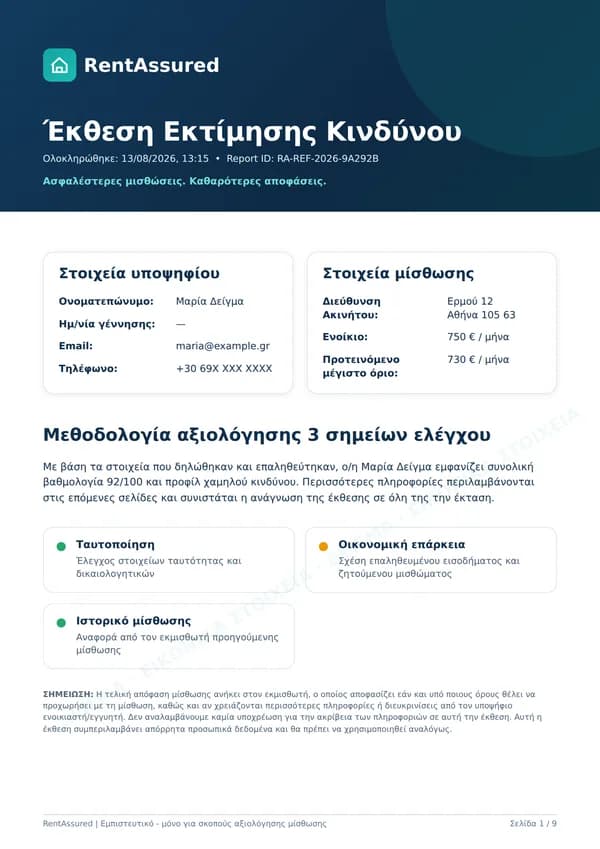
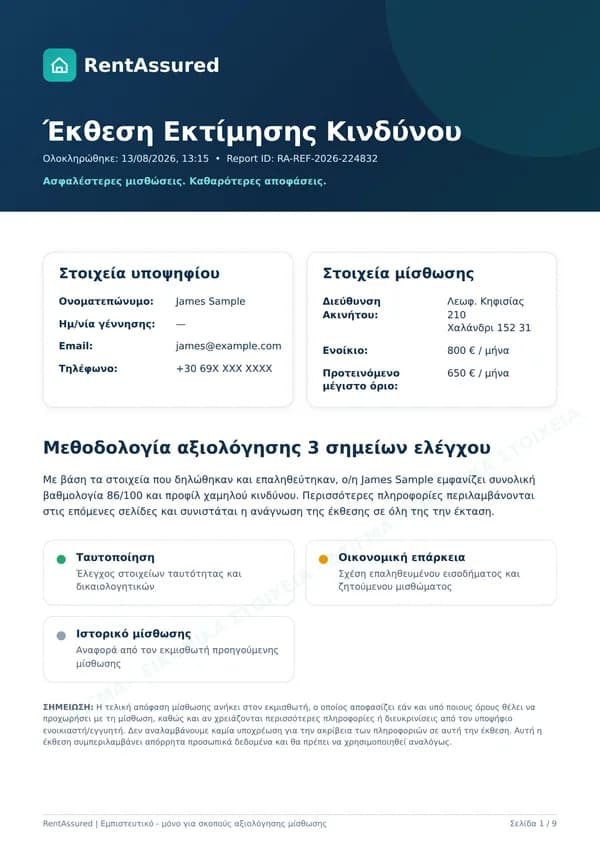
Three complete samples with fictional data: a typical low-risk profile, an applicant with no Greek rental history, and a case where a guarantor is recommended.
 9 pages
 9 pages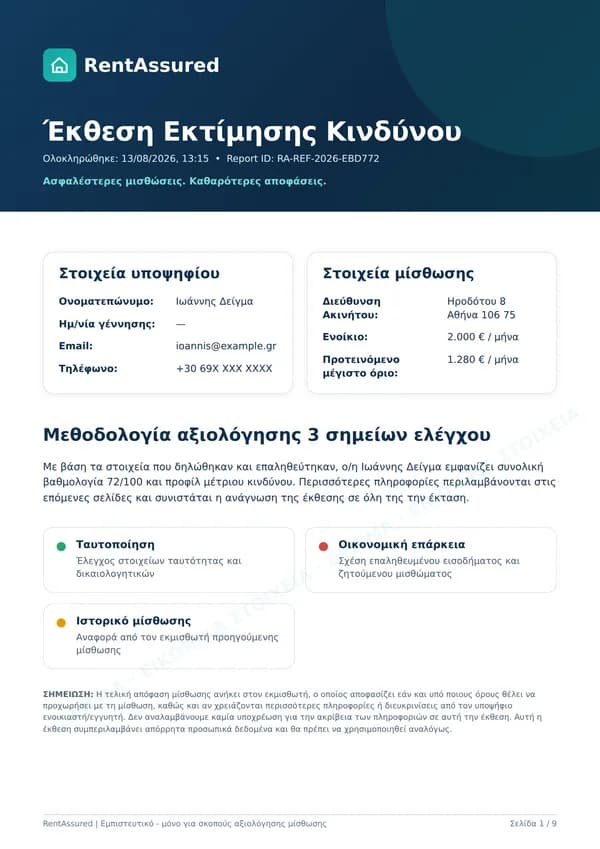
Every name, document and contact detail in the samples is fictional.
How the risk score is calculated
The report carries one number out of 100 and a risk word. The number is the plain average of the category scores that actually have data behind them. A category with nothing behind it is left out of the average — never counted as a zero, because “not asked” and “failed” are not the same thing.
Score = average of the categories that have data
Identity
Scored by how far the identity check actually got — not by what was claimed. A verified check carries the full 100; a submission our team has not yet confirmed carries 75; a declined check carries 0.
Affordability
Rent measured against income. The declared gross annual income is divided by twelve, the asking rent is taken as a share of that, and the score falls on a straight line between the two ends of the scale.
Tenancy history
The previous landlord's four ratings, averaged and put on a 100-point scale. A reference that was sent but never answered scores nothing and is shown as pending; a tenant with no past tenancy to declare is not penalised, the category is simply left out.
The affordability scale
Rent at or below 30% of monthly income scores the full 100. At or above 75% it scores 0. In between, the score falls in a straight line — there is no cliff edge and no hidden weighting.
| Rent as a share of income | Affordability score | How the report reads it |
|---|---|---|
| 25% | 100 | Within range |
| 35% | 89 | Within range |
| 50% | 56 | Marginal |
| 65% | 22 | Out of range |
| 80% | 0 | Out of range |
Up to 35% is within range, up to 50% is marginal, and above that the rent absorbs a disproportionate share of the income.
An unchecked claim cannot score like a checked one
Whatever a category would otherwise score, it is capped by how far the underlying step has got. This is why a perfect-looking application that nobody has reviewed yet never shows a perfect score.
| State of the step | Most it can score |
|---|---|
| Not started | Not scored |
| In progress | 25 / 100 |
| Waiting on a third party | 40 / 100 |
| Submitted, not yet checked | 75 / 100 |
| Verified by our team | 100 / 100 |
| Rejected | 0 / 100 |
What the previous landlord is asked
Four criteria, one to five stars each, plus a free-text comment. The average of the four is what the tenancy-history category scores.
- Paid the rent on time1–5 ★
- Looked after the property1–5 ★
- Communication and co-operation1–5 ★
- Kept up with bills and service charges1–5 ★
An average of 4 or more reads as a positive reference, 3 or more as mixed, and below 3 as negative.
From a score to a verdict
Low risk
80 and above
Medium risk
55 to 79
High risk
Below 55
Under assessment
No category scored yet
A person has the last word
The computed score is a starting point, not the verdict. A RentAssured reviewer reads the file, can set the score and the risk level themselves, and writes the recommendation that closes the report. Where they have done so, their figure is the one shown and the report records that it was reviewed.
The report is an assessment, not a decision. Whether to let, and on what terms, is always the landlord's call.